Thursday, March 3, 2011

Week 7


The Birmingham Public Library houses some unique archives, including a set of museum archives from the BMA. This week I was sent to the archives to examine what they had, and see how their finding aid was set up. The archives are located in the basement of the original structure of the Birmingham Public Library. The library itself is fascinating, and the map/reading room features a very unique mural painted along the entire upper walls. It might be interesting to explore the history of this building, and the meaning behind the the murals at a more appropriate time. This visit however was focused on the archives.

After checking in with the archives staff, and signing a form promising not to damage or remove items form the archive I was shown the finding aid, and provided a form to request specific folders. The archive of the BMA included a variety of documents, correspondence, and information. Their materials extended from the 1950's through the 1980's and had many items not present in the archive I have been working on. For example; I examined a handbook from the 1950's for air raid safety that specifically addressed what to do in a nuclear attack. This handbook was distributed to all Jefferson County municipal buildings and was likely present in the museum when it was first opened to the public.

After explaining that I am a library science student interested in archives, I inquired as to the possibility of a brief tour of the facility. The staff were extremely excited and were more than willing. I saw the rows of electric movable shelves ( which were explained as being far longer than most movable shelving units), and was shown the area where records were processed and preserved. Among the many items in their archive were the blueprints and plans for almost every structure in the city of Birmingham. The collection of archives at the Birmingham Public Library were impressive.

In addition to the archives visit, I attended a meeting with Ms. Preston about upcoming improvements being implemented for the museum Web Site. New improvements discussed included adding additional content like podcasts, and links to videos from lectures and educational programs. A more user-friendly interface that includes  a "bread crumb" trail as the user navigates the site is also planned. The improved version of the Web Site offered many possibilities.                   

Friday, February 25, 2011

Week 6


The first phase of updating and expanding the institutional archive is almost complete! All but two boxes have been emptied, their contents sorted, identified and briefly described. Above, is one such emptied box.The next phase will consist of creating more accurate descriptions of the objects, and placing them in secure archival standard storage. The descriptions will help expand and develop a new finding aid which will represent a more complete picture of the Birmingham Museum of Art Archive, and provide users with more complete information.

As I examined the box that contained correspondence between museum officials, I found a letter from 1980 written by the first vice chairman of the museum board. In this letter, he outlined the origins of the Birmingham Museum of Art, and explained that there had been several myths on these origins that had been published in local newspapers and museum documents. He added that he found it amazing that the official history could be so quickly forgotten, considering that the museum was initially opened in 1951 ( written in 1980, this was less than 30 years after the founding of the museum). He went on to elaborate on how the Birmingham Museum of Art emerged from the Birmingham Art Club, founded in 1908, and formed with the goal of creating an art museum in Birmingham. The former vice chairman added that when he approached one of the authors of the erroneous history and explained what was stated incorrectly, that author shrugged it off and said it didn't really matter. He concluded by quoting Napoleon in stating that history should not be "a fable agreed upon," and submitted this letter in the hopes of establishing a more accurate account of the past. The images below show the fist and last pages of this letter.


This letter serves as an illustration of the importance of libraries and archives. Without the proper preservation of recorded historical events and people, a full understanding of the present cannot be reached. When the Birmingham Museum of Art Archive has been fully updated, these records will be more freely accessible, and a more successful future could be built on what was previously accomplished.       

Friday, February 18, 2011

week 5

As I worked on the archive this week I learned more about the ongoing efforts to expand shelving in the Hanson Library. I also learned about preservation, and what to do about archival objects that have been damaged.


The image above illustrates the planned shelving expansion. Since the library is non-circulating, the circulation desk would be removed and replaced with tables and seating for patrons. This is represented by the three orange table areas in the above plan. Where tables are currently located could then be used to extend the current shelves for the collection, as depicted by the black bars above. Ms. Preston showed me a document that described the shelving process, and explained that she and other museum staff had considered the option of collapsible shelving. Ultimately it was decided that this option was not practical as the cost was prohibitive, and patron access would be more limited.    

In addition to the ongoing shelving issue, while working on the archive I identified a number of items that were water damaged and moldy. These items were separated form the collection, and prompted a discussion on archival preservation. Freezing moldy items, and what to do with film that has deteriorated due to vinegar syndrome were discussed. The items in question for this archve were exhibition catalogs.  Several copies of these items were kept, so it was decided to dispose of the moldy sets. I am pictured below placing these items in the trash receptical.


Friday, February 11, 2011

Week 4

Last week I had thought I had finished with the clippings, and would be starting on scrapbooks. However as I examined some of the scrapbooks, I quickly discovered they were actually more clippings glued chronologically into books and separated by year. According to the original finding aid (which will have to be expanded and modified in order to accommodate new items I have found) the clippings were stored in this fashion. The dates of these items ranged from the 1960's through the early 1980's. I sorted these items, and now have a record of clippings that begin in the 1960's and go through the early 2000's. These clippings will all be scanned and stored digitally.

Some of the items I examined were scrapbooks, and the range of information in them was fascinating. Examples include scrapbooks devoted to the annual Museum Ball fundraiser, scrapbooks describing the events of the Birmingham Museum of Art Women's Committee, and a set of scrapbooks detailing the world of art from articles and magazines published before the founding of the museum. The images below depict a sample of Women's Committee scrapbooks, and a page from a Museum Ball scrapbook featuring an invitation.


It was interesting to learn of the influence the Women's Committee had on the museum. It was not unlike the role women's organizations played in the development of libraries in the early 20th Century. For example, from the founding of the museum in the 1950's through the early 1970's it was the Women's Committee that developed and organized the lecture series. There are scrapbooks that detail the efforts and successes these women shared, and they provide excellent documentation.

The three sets of scrapbooks describing art and artists before the museum was created were also very interesting. The image below illustrates one example.


Some of the pages in these scrapbooks are loose, and the advertisements found on the back are equally interesting, and provide a snapshot of American culture. These items will be kept, but for the time being they have been separated from the rest of the collection.   

Friday, February 4, 2011

Week 3

      While working on the museum archive this week I learned much about both the museum and the Hanson Library. In 1993, the museum reopened after a two year closer and $20 million expansion. The expansion added two new wings to the museum, a sculpture garden, a theater, and a permanent space for the Clarence B. Hanson Library. The expanded building was designed by architect Edward Larrabee Barnes (more information on this architect can be found here). This expansion ensured that the Birmingham Museum of Art would be the largest art museum in the South East. In addition to the largest collection of Wedgwood outside of the UK, the museum is also home to a renowned collection of Asian, South American/NativeAmerican, and African art.
      More recently, the Hanson Library acquired new collections bringing the total collection of volumes to 30,000. These new collections include the Buten Library and Archives ( a Wedgwood collection that significantly adds to the current collection), the Artemis Library (from the former Artemis Library in London), and the Robert Kaufmann Library ( a 2,000 volume collection of books on art history and Victoriana). These additions greatly enhance what was already a comprehensive research art library.
     I have just about finished the first part of the Museum Archive. The image below illustrates the materials to be included in the archive and how they line the stacks of the library waiting to be scanned.
 
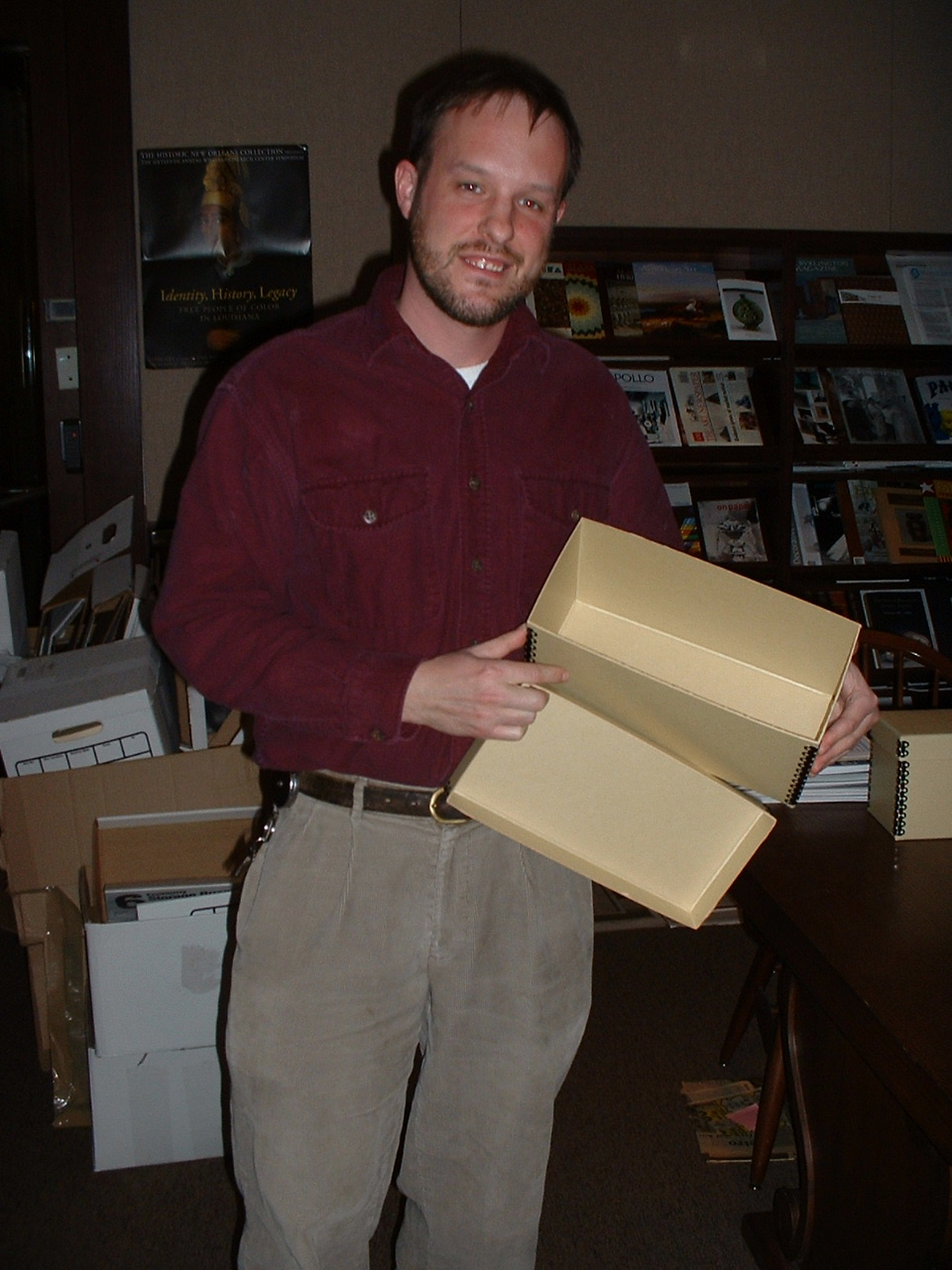
      In addition to this, several VHS tapes were examined, and those that were to be included in the archive were sent to a company that will convert them to DVD. Archival boxes for the storage of these discs were ordered. I am pictured below with one of these boxes.
 The next items to be sorted for the archive include several museum catalogs, and scrap books. More on that next week.


Friday, January 28, 2011

Week 2

After having worked in the library for about 2 weeks I have learned much. Ms. Preston is the only librarian and has many responsibilities in this position. In fact, she is co-authoring a book describing the operations of running a library solo. The museum and museum collection  have grown over the past two decades, and as a support to this institution, the collection and resources available in the library have also grown. This rapid growth has exceeded the available space within the library, and one of the projects Ms. Preston is working on is developing more shelving space. The image below illustrates this problem.
    The library houses several archives. The archive that I am working on ( museum archive) is partially complete. The image on the bottom shows the portion of the archive that has been done, and the image on the top provides a visual of the portion I am working on.


As stated in the last post I have begun by sorting material. The items I have sorted so far are from previous exhibitions. I have been dividing them alphabetically, by exhibition title. The items pictured below were all stored randomly in vertical files. I have separated these items based on each exhibition, and have labeled them with a post-it.   After I have completely sorted these resources, I will be scanning them and creating a digital record of each item.
 

Friday, January 21, 2011

Week 1


      This posting describes the first few days of my practicum in the Clarence B. Hanson Library in the Birmingham Museum of Art. A link to the library Web site can be found here. For those readers who do not know me or my background, I am a graduate student in the Library and Information Science program at the University of Southern Mississippi. I have a background in art, and I have worked in libraries. It is my ultimate hope to combine these passions by one day working as an art librarian in a museum or gallery. This practicum will provide me with valuable experiences that could be used as a starting point towards this goal.
     For my practicum I am working with the museum librarian, Tatum Preston, in the development of the museum archive. The archive is somewhat incomplete, as it had not been properly maintained for several years. I began my first week by familiarizing myself with both the museum collection, and the materials to be included in the archive. In addition to this, Ms. Preston secured a state funded grant to assist with the archives project, and the two of us attended a mandatory workshop at the Alabama Department of Archives and History as required for the funds. The workshop described basic archival processes, and offered information that could be used to develop an archive. The workshop also included a brief tour of the Alabama State Archives.
      As a starting point for this project, I examined all the boxes of material that are to be archived. The boxes containing written reviews and newspaper articles seemed to outnumber the other items, so I began by sorting these publications. The majority of these texts describe exhibitions the museum presented, however there are a few other pieces of literature that describe the museum in general. Other items I have yet to sort include exhibition catalogs, artist files, and several scrapbooks. These items are all out of order, and sorting them seems like a logical starting point.